
Meta AI chat
Center-stage chat on Muse Spark 1.3 (default) or Muse Wonder 1.0, with workspace context, research-brief context, history, and Stop/cancel.

Case study · KryomLabs
A Meta AI-powered desktop IDE that bridges scientific research and software engineering — where every AI-assisted change is proposed, reviewed, approved, and verified, with the evidence kept alongside the code.
An independent KryomLabs project integrating Meta AI models through their API; this does not imply official endorsement by, or affiliation with, Meta. Facts on this page are verified against the public repository README.
Overview
KryomCode is an AI-assisted coding and scientific research desktop workspace. It keeps the whole development chain in one Meta-first environment: research with cited sources, source-grounded plans, diff review, explicit approval, then verified execution.
It does not claim to replace every IDE or coding agent. Instead, it is the place where AI assistance is always proposed, reviewed, approved, and verified — with the evidence kept alongside the code.
Problem & motivation
Papers get read, then implementation starts from a blank file with no trace back to the evidence. Meanwhile AI coding tools either act without review or bury their reasoning where it cannot be checked.
The result is code nobody can audit: no sources, no plan record, no proof that verification actually ran. KryomCode exists to close that gap.
Vision
KryomCode is built toward a workspace where a single builder can move from a research question to reviewed, verified implementation without losing the chain of evidence — and where every AI suggestion arrives with its reasoning visible and its execution gated behind human approval.
The long-term direction is evidence-driven AI-assisted engineering and scientific research. Intended application areas include robotics, quantum computing, scientific computing, machine learning, and aerospace — directions for the product, not claims that every specialized workflow is already implemented.
How it works
One fixed pipeline from question to verified code. Each stage hands evidence — not just output — to the next.
Under the hood
Three layers, one trust direction — the renderer never touches disk, network, or secrets. Electron 45 · React 19 · TypeScript 5.7 · Vite 6.
Renderer
React UI shell · sandboxed
Preload bridge
window.kryom · no Node APIs
Main process
Node + Electron · services
Drawn from the repository's documented architecture. Full details live in the project docs — see the links section below.
What it does
Implemented and evidence-backed — each capability below is documented in the public repository.
Center-stage chat on Muse Spark 1.3 (default) or Muse Wonder 1.0, with workspace context, research-brief context, history, and Stop/cancel.
Task to validated plan to per-edit approval, with atomic apply, rollback, checkpoints, per-item undo, and freshness protection.
Visible run steps, persisted sessions, cited markdown briefs, source lists, .docx export, and Implement-from-Research handoff.
Citations must resolve to retrieved sources; claim checks are lexical and labeled as such; model prose is marked AI-generated.
Why-rationale plus diff per edit, change-set ordering, same-file conflict blocking, and digest-checked undo of pre-apply bytes.
Multi-tab editing with dirty tracking, session restore, conflict dialogs, auto save, and locally bundled workers (no CDN).
One explicit run per command with timeout, output caps, secret scrubbing, advisory warnings, and cancel/status controls.
Status, diffs, stage/unstage, confirmed discard, commit, push, fast-forward-only pull, and restricted clone sources.
Reports derive from observed run facts — exit codes and run ids — never from model prose. Stale steps are flagged, never faked.
Built with
Claim verification uses lexical matching and is labeled as such — the project does not claim semantic search for these integrations.
Plans propose, humans approve
Every file edit needs explicit selection; apply, run, skip, and undo each confirm first.
Destructive commands need native approval
Main-process approval for destructive terminal commands that a compromised renderer cannot skip.
Checkpoints before every apply
Pre-apply bytes persist with digest-checked undo; failures roll back with honest counts.
Sandboxed renderer
Context isolation, no Node integration, full sandbox; navigation restricted; CSP allows no remote hosts.
Secrets stay sealed
Environment allowlist plus OS-encrypted vault; terminal and Git children get scrubbed environments.
Bounded recovery
Failed checks enter a bounded repair cycle (2 attempts, 10-minute budget) with per-attempt approval.
How it shipped
Milestones with documented dates. Anything undated stays unspecified.
Real captures
Authentic captures from the running app (dark theme), served from the project repository with their documented captions.
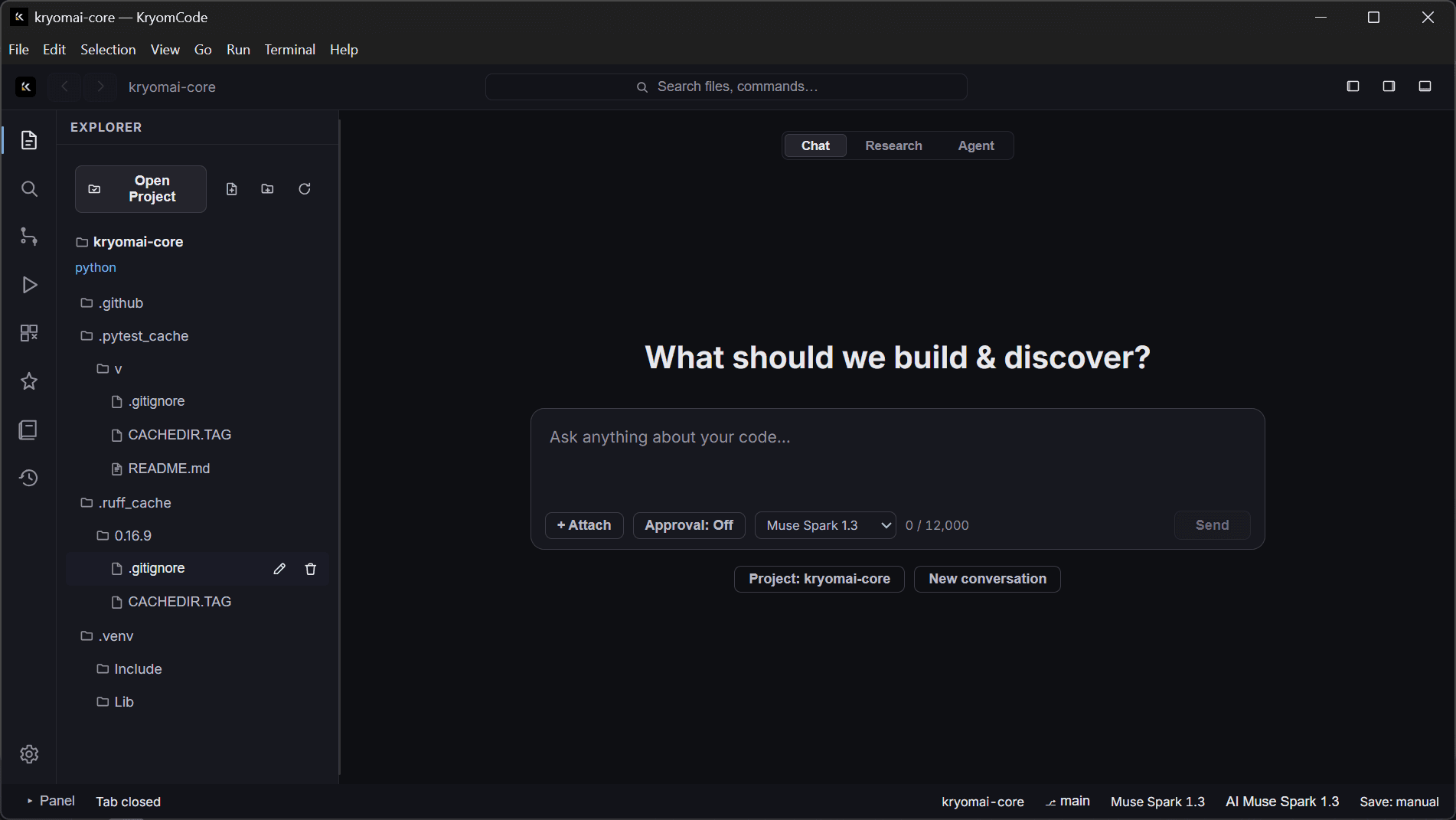
01 · Main workbench
Welcome view with Chat/Research/Agent modes, Explorer, prompt box, and per-request model picker.
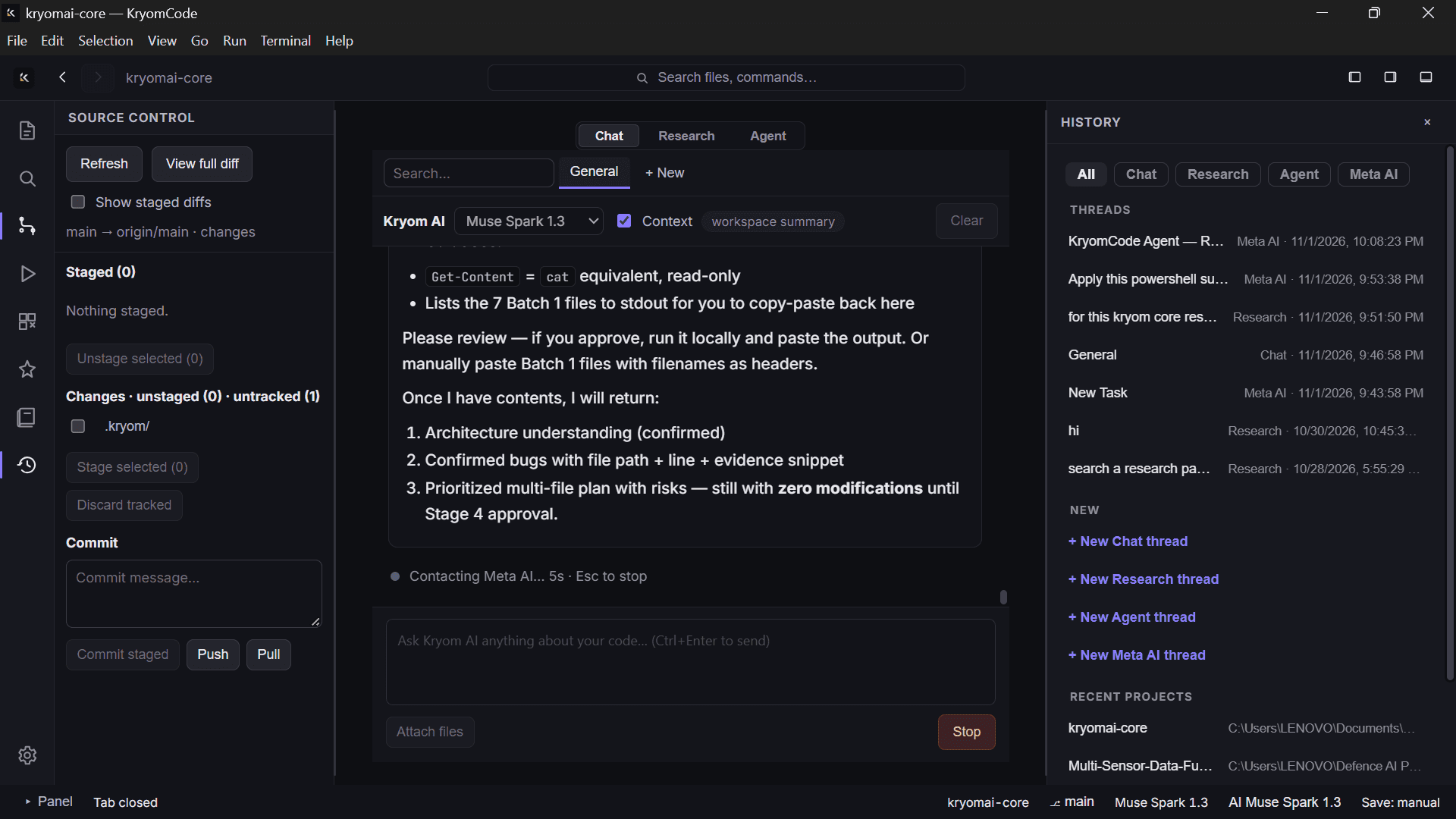
02 · Meta AI chat
Live request with elapsed timer and Stop, workspace context chips, and filterable thread history.
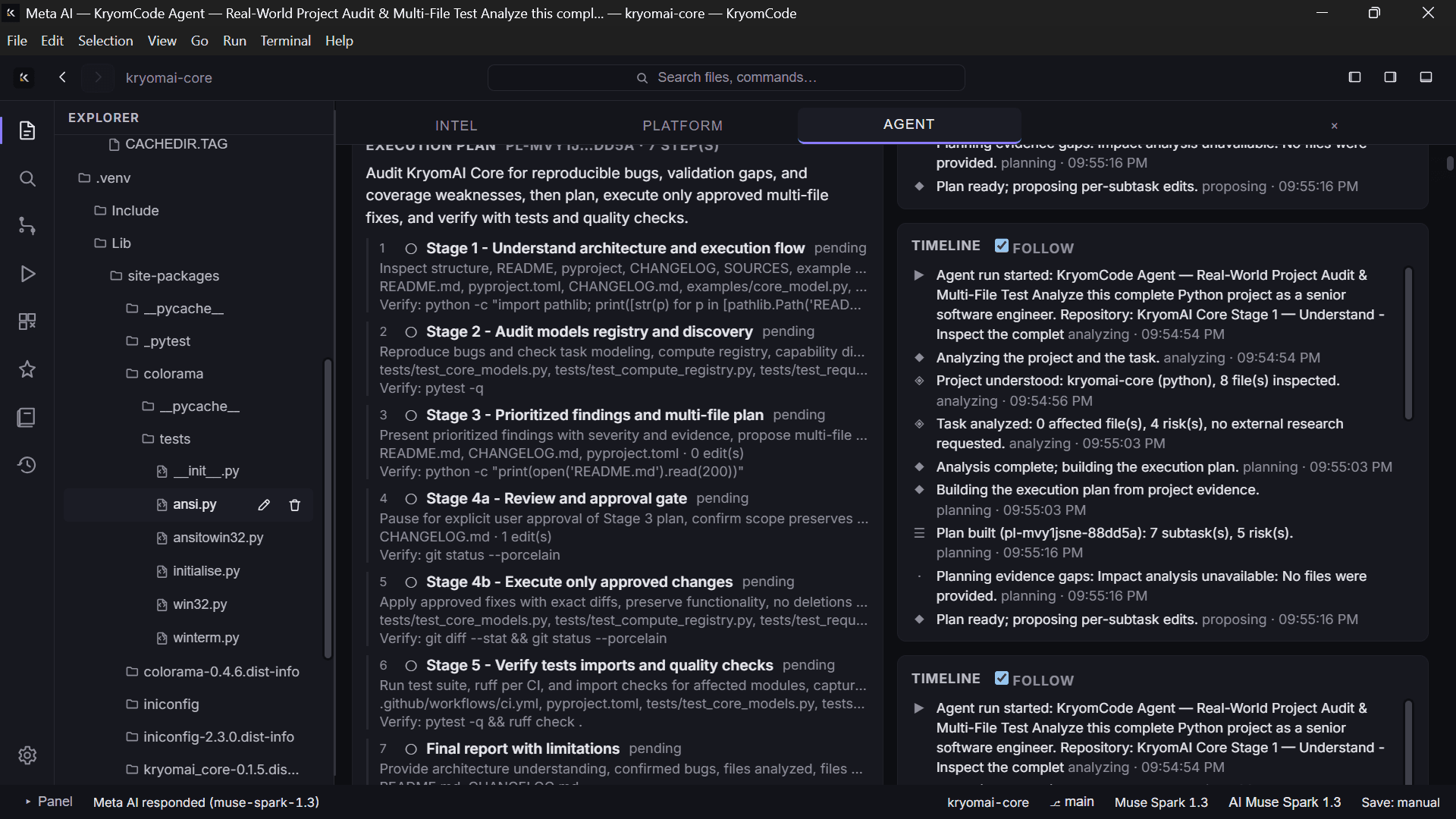
03 · Agent planning
Staged execution plan with per-stage files and Verify commands, explicit approval gate, and live run timeline.
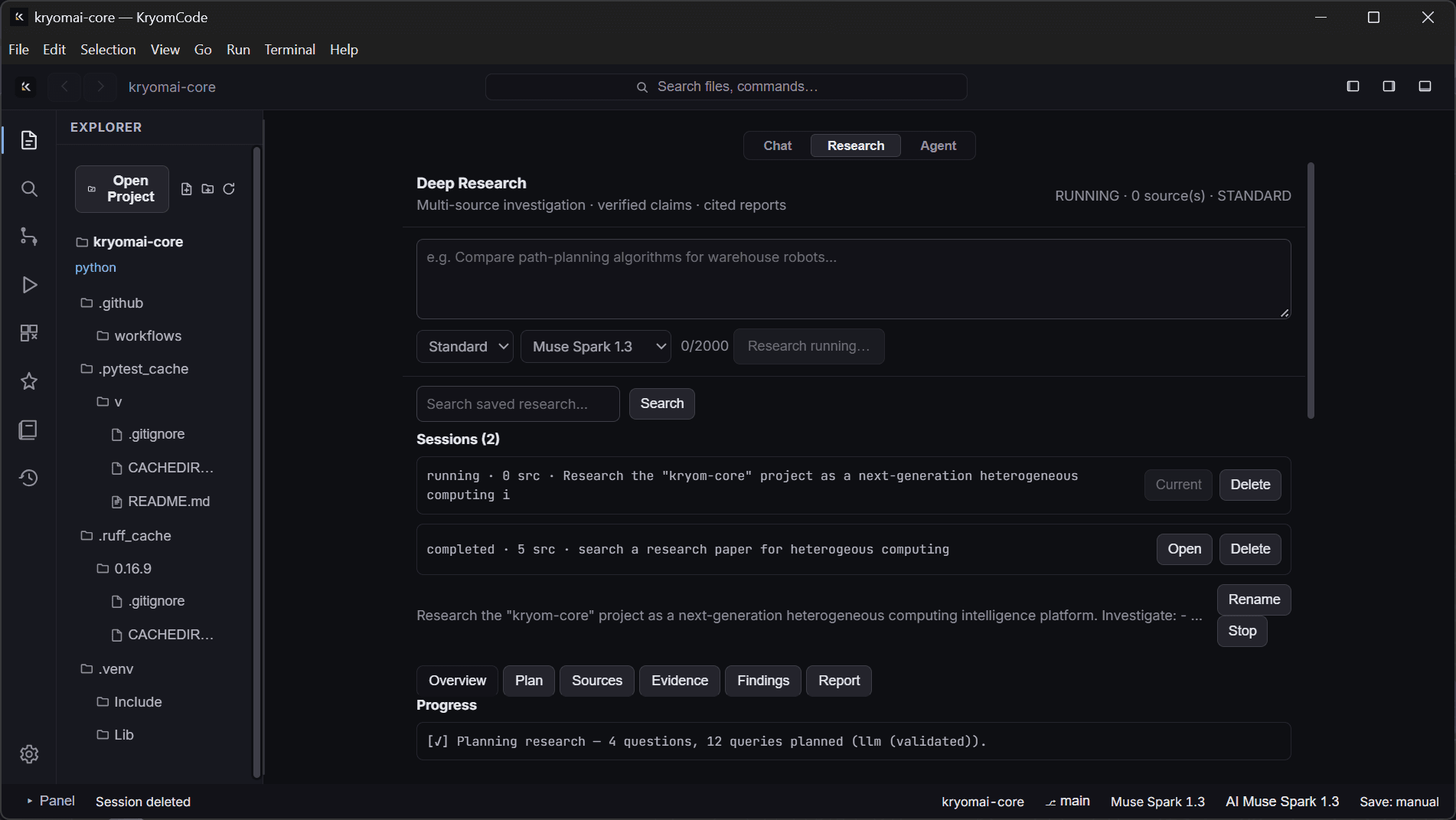
04 · Research workspace
Persisted sessions, validated multi-query planning progress, and the Overview-to-Report tab flow.
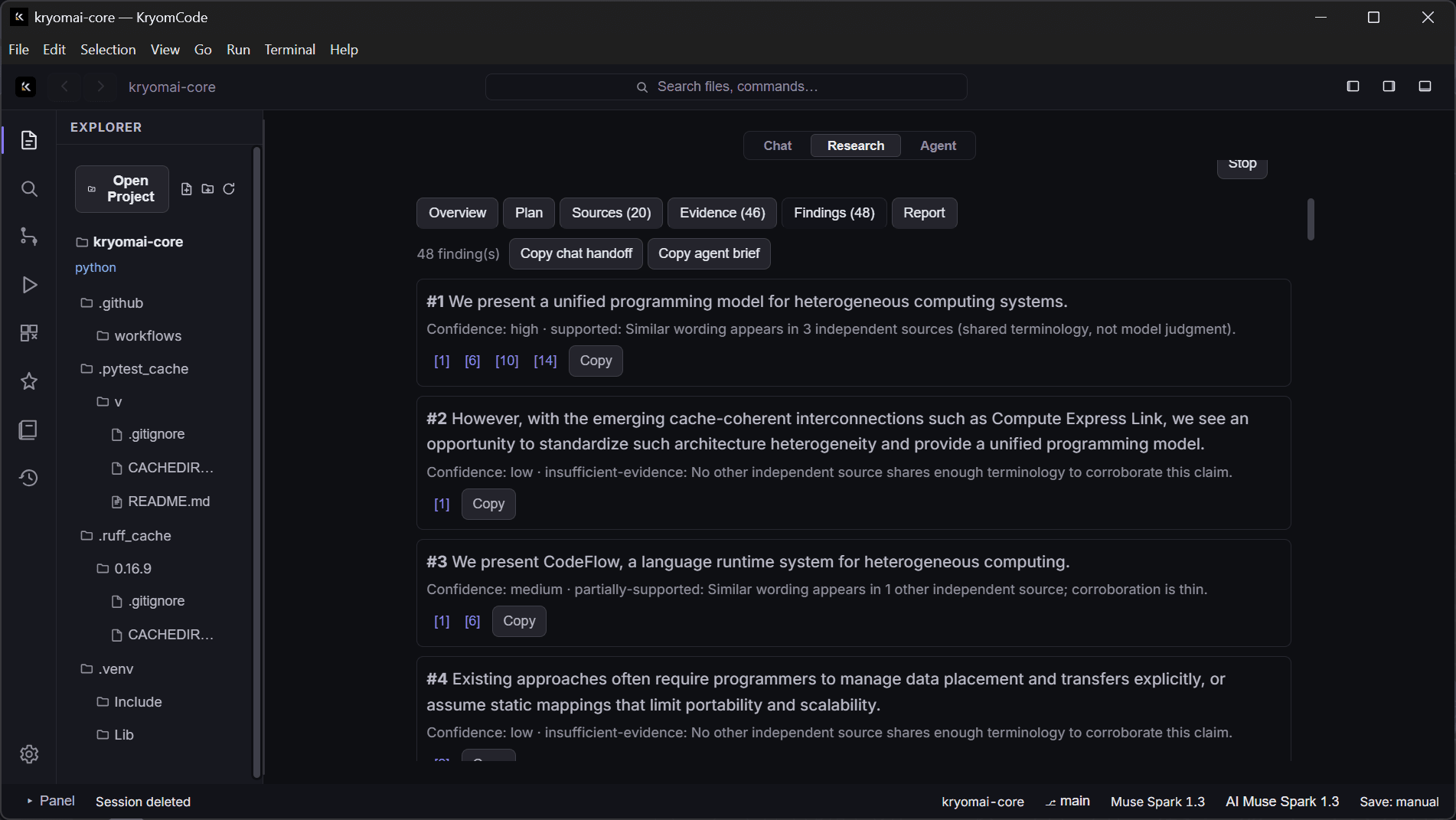
05 · Research evidence and citations
Confidence-graded claims with numbered citations and one-click handoff briefs for chat and the agent.
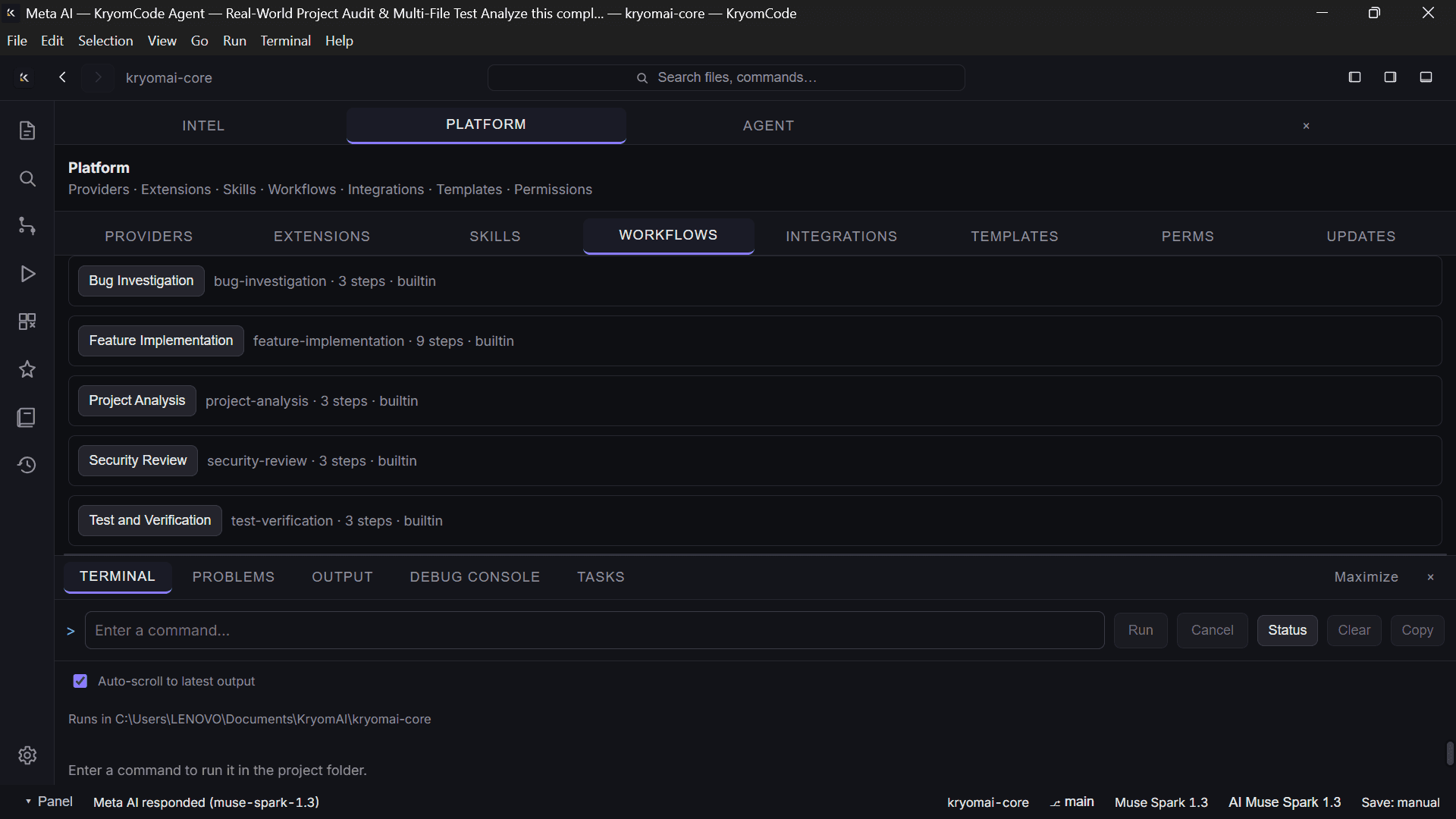
06 · Integrated terminal
One-shot reviewed execution with Run/Cancel/Status/Clear/Copy, above the Platform workflows tab.
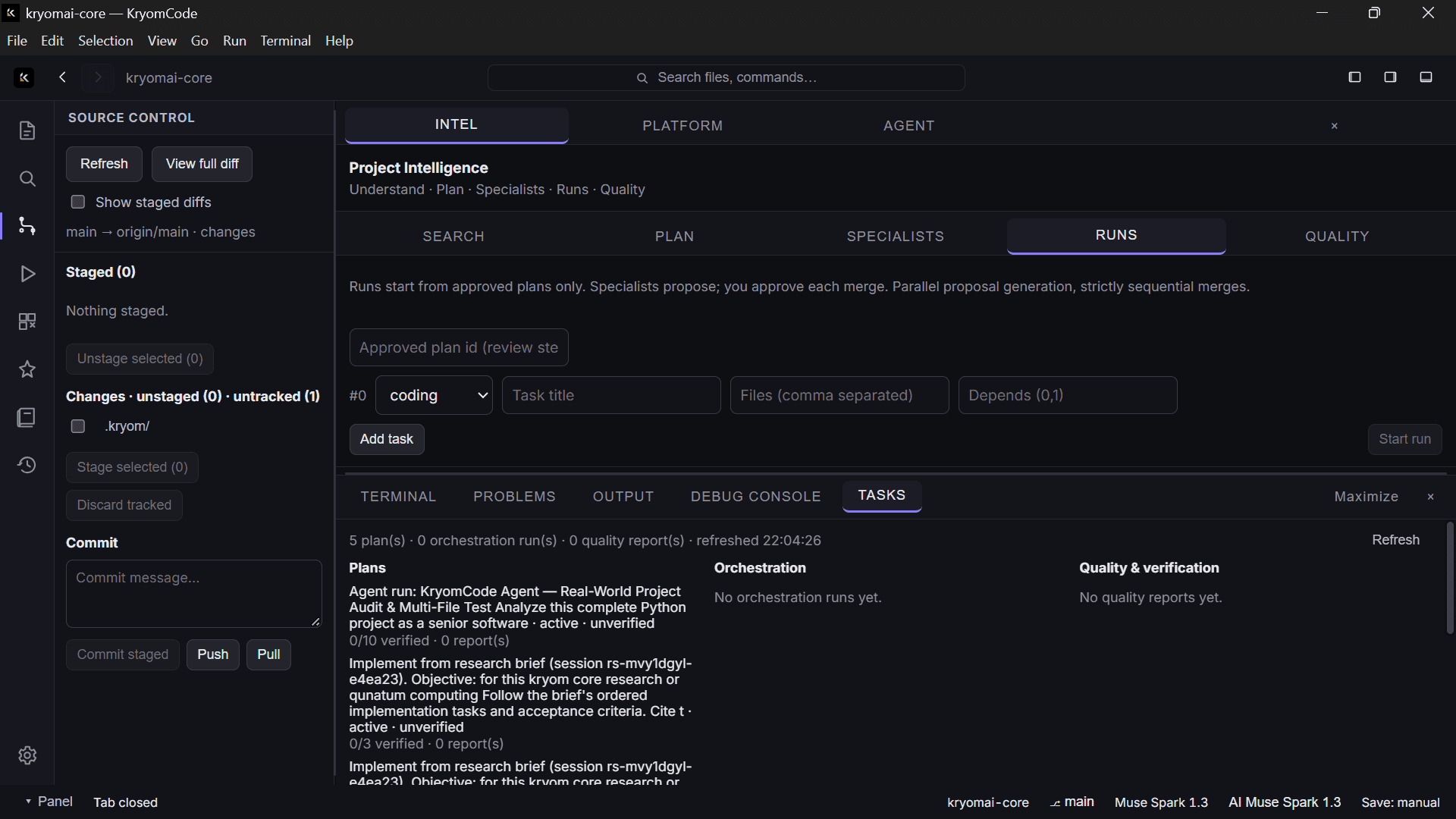
07 · Git source control
Staged/unstaged/untracked, commit, Push/Pull, plus the Tasks panel with plan verification states.
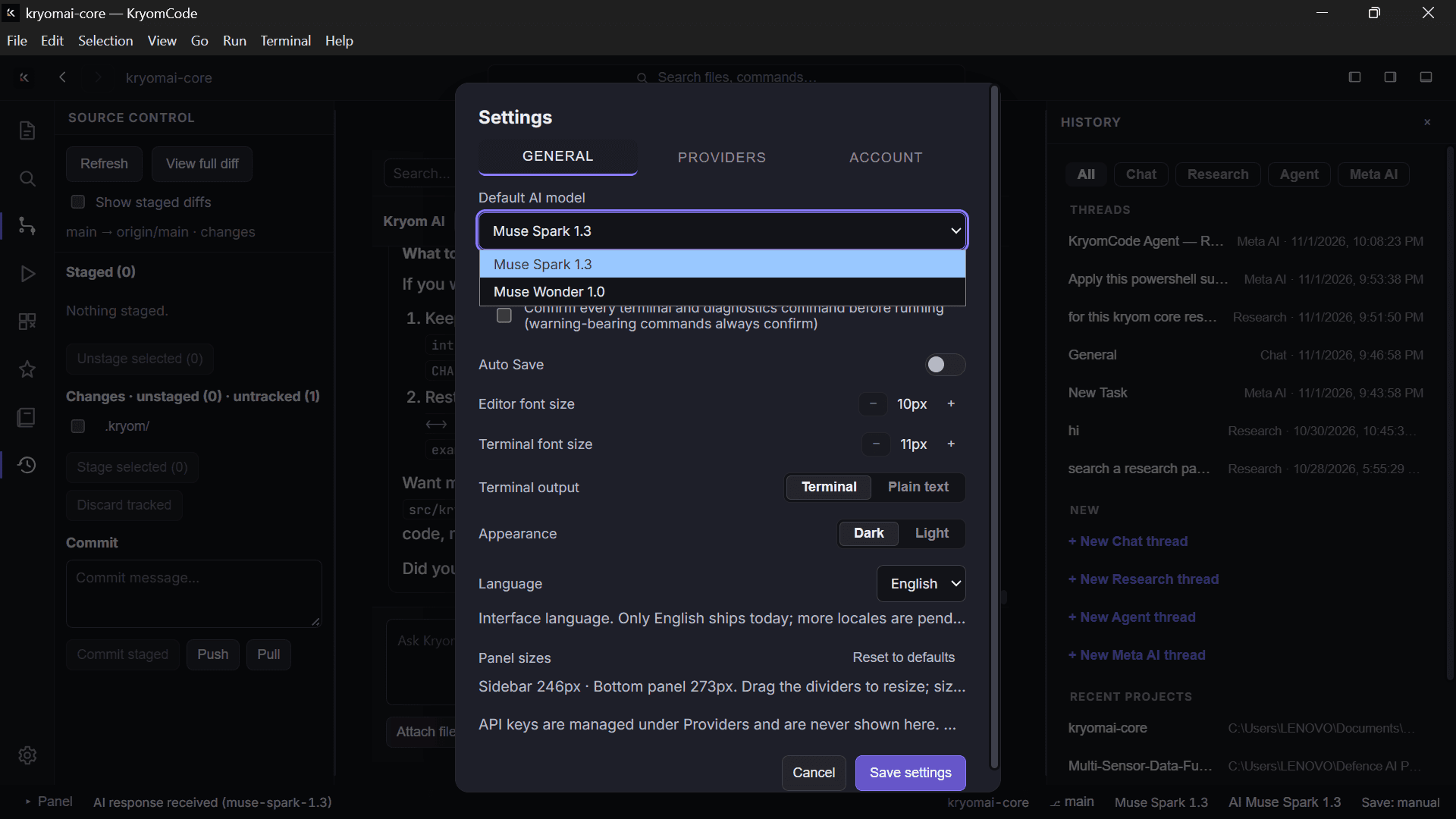
08 · Meta model configuration
Settings picker with both Muse models; API keys are managed under Providers and never shown.
Source: KryomCode repository docs gallery. Additional supplementary shots stay in the repository outside this gallery.
In motion
The official 2:16 hackathon demo, recorded 2026-11-02 following the published demo script.
H.264 1080p · AAC stereo · 2:16
Watch on YouTubeGet it & follow it
Honest scope
What is next
Three-OS CI matrixDone
First full matrix runs recorded — completed 2026-11-03.
macOS and Linux hardware validation
Build, launch, and smoke-test installers on real machines. Blocked: test machines.
Signed installers
Windows certificate plus Apple notarization. Blocked: certificates.
Hosted update feed
Automatic update channel. Blocked: hosting.
Streaming output and more parsers
Ideas only — no commitments or schedule.
Roadmap order follows the repository; nothing beyond the completed item is scheduled or promised.